
Subscribe to the podcast!



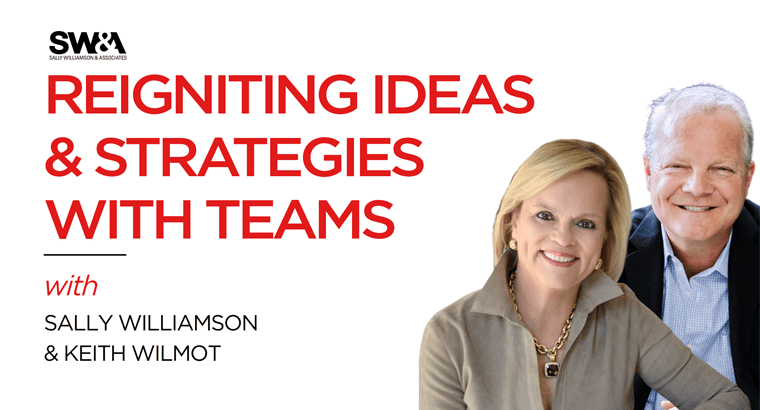
Team Innovation Strategies with Keith Wilmot
How do leaders foster innovation in teams when daily demands leave little time for new thinking? Innovation requires more than gathering people in a room and asking for ideas. Teams need a clearly defined challenge, permission to question familiar approaches and a process for moving promising ideas into action.
In this episode of What’s Your Story?, Sally talks with Keith Wilmot about how his agency, Ignitor, helps organizations blend creativity with disciplined execution. Keith’s career has included more than two decades of leading innovation for major global brands. His experience reveals why teams get stuck, how leaders can broaden their thinking and what it takes to build innovation into the organization rather than assigning it to a select few.
The conversation also explores collaboration across virtual and in-person environments, the role of a growth mindset and an essential distinction: ideas matter, but their value is ultimately measured by what the organization can realize from them.
Many teams are capable of generating strong ideas, but everyday pressures, familiar processes, and fixed ways of thinking can make innovation difficult. That is why team innovation strategies are so important.
In this episode of What’s Your Story, Sally talks with Keith Wilmot about how leaders can help teams get unstuck. Keith explains how process, creativity, collaboration, and intentional leadership behaviors can help organizations see challenges differently and move promising ideas toward meaningful action and team innovation strategies.
It’s safe to say we all wish we could wake up every day and bring everything we have to the roles we’re in. Each day would be a new day, every agenda a clean slate. But the reality is that many of us are in roles that are a little messier than that.
Team Innovation Strategies
So messy in fact that getting to new ideas or exploring an out-of-the-box concept isn’t easy. In fact, with a pile of problems and challenges in our every day, new ideas can feel impossible.
Unless you’ve spent time with Keith Wilmot.
In our latest episode of What’s Your Story, Sally talks with Keith about how his agency, Ignitor, helps teams get unstuck by blending process and creativity to release new ideas and broaden the lens on most situations and team innovation strategies. And he also has a wild story to share about his own experience with getting unstuck. And how to move your employees forward through team innovation strategies
More about Keith Wilmot
Keith’s successful career spans over two decades of leading innovation and creativity for global brands and driving team innovation strategies for companies such as Coca-Cola, Listerine, Neosporin, Brach’s Candy and many more. Keith has extensive experience in global, publicly traded organizations, as well as leading small, privately held firms. He is described by his team as a student of leadership and disciplined operator with a unique skillset of money and magic that drives team innovation strategies.
Show Notes
- Coca-Cola Company
- Built an internal agency called Ignitor
- Built innovation capability, behaviors, and mindset shifts in the organization to allow creativity to happen inside the organization.
- McDonald’s
- Nandos
- Mercedes-Benz
- The first company to create the crash dummy and the crash dummy process
- Leaders get stuck in some core behaviors and mindsets that force certain types of processes and operations and organizations.
- Impact efficiency
- Impact teams and organization
- If they’re not intentional about breaking those patterns and looking differently at their organization, those areas of getting stuck can be pretty damaging to an organization.
- Decentralization of the innovation strategy – a decentralized approach to creativity in an organization and innovation, meaning that every single person that\’s in your organization is responsible for and owns the innovation agenda of the company
- Virtual vs In Office workers
- Ignitor believes it’s about engagement and collaboration, If meeting in person teams must make meetings more intentional. If teams are going back into the office, you’ve got a whole new cultural challenge.
- Salesforce
- It’s important to make sure companies are still bringing people face-to-face.
- How to clarify the challenge of team innovation strategies, and how do to clarify what you’re trying to solve for?
- Several tools that go into helping organizations, brands, people, and leaders better clarify the challenge.
- Insight and finding insight in places that you normally wouldn’t find.
- Suite of eight behaviors and six mindsets that accelerate collaboration, and innovation creativity in the teams and the organization.
- Growth mindset, and it’s the difference between a growth mindset and a fixed mindset.
- What are the most important initiatives?
- What are the initiatives that we believe are going to deliver the most value?
- Coca-Cola Red
- The worst place for an HR leader in an organization to be is in their office.
- Why hiring a group like Ignitor for offsite and onsite training is more effective than having the leader of the organization add it to their list.
- Norwegian Cruise Lines
- We’re innovators that are powered by inspiration that powers us, but we’re measured by the realization of ideas. So a team has to come to a point where whatever they create together has got an output, and has an impact on the organization
- When did Ignitor fail an organization?
- Ronald McDonald House charities
- Animal Kingdom Lodge
- What is your 600-pound white Siberian tiger story?
Why Teams Get Stuck
Teams rarely run out of intelligence, experience or ideas. More often, they become trapped by established patterns.
A process that once created efficiency can eventually limit exploration. A decision-making structure that worked for a smaller organization can become a barrier as the company grows. Leaders may continue approaching a challenge in the same way because that approach is familiar, even when it no longer produces the desired result.
Getting stuck can also be difficult to recognize from inside the organization. Teams know the history behind their processes. They understand the limitations, personalities and previous decisions that shaped the current approach. That knowledge is valuable, but it can also cause people to accept constraints without questioning whether they still apply.
Leaders who want to foster innovation in teams must make room for a different perspective. They have to help people separate facts from assumptions and current requirements from inherited habits.
The first question is not necessarily, “What is the new idea?”
It may be, “What have we stopped questioning?”
Team Innovation Strategies: Innovation Requires Creativity and Process
Creativity and process are sometimes treated as opposites. Creativity appears spontaneous, while process sounds structured and controlled. Effective innovation requires both.
Creativity helps a team imagine what could be different. Process helps the team decide which ideas have value, determine what is possible and move the strongest options forward.
Without creativity, teams continue refining what already exists. Without process, good ideas may generate enthusiasm but never produce an outcome.
Keith describes this balance as bringing together “money and magic.” The magic is inspiration, imagination and the willingness to look beyond the obvious. The money is the discipline to evaluate an idea, connect it to organizational priorities and turn it into something useful.
Leaders should not impose so much structure that new thinking disappears. But they also should not confuse a high-energy brainstorming session with innovation. A room full of ideas is a beginning, not a result.
Team Innovation Strategies: How to Foster Innovation in Teams
Clarify the Challenge
Teams produce better ideas when they understand the problem they are trying to solve.
A challenge such as “We need to be more innovative” is too broad to guide productive thinking. Team members may interpret it in completely different ways. One person may focus on products, another on internal processes and another on the customer experience.
A clearer challenge might be:
- How could we reduce the time it takes customers to receive an answer?
- How could we make this process easier for employees to use?
- How could we deliver more value without adding unnecessary complexity?
- How could we improve collaboration between these two functions?
- What would have to change for this strategy to succeed?
Clarifying the challenge does not limit creativity. It gives creativity a useful direction.
Before the team starts generating solutions, leaders should confirm that everyone understands the audience, need, desired outcome and relevant constraints. This is where communication becomes essential. If the team is solving different versions of the problem, even strong ideas will pull the organization in different directions.
Make Innovation Everyone’s Responsibility
One of the most important ideas from Sally’s conversation with Keith is the decentralization of innovation.
Innovation should not belong exclusively to a designated department, senior leadership team or small group of people with creative titles. Employees throughout an organization see problems, customer needs and opportunities that leaders may never encounter directly.
When innovation is centralized, employees may assume that improving the business is someone else’s responsibility. They follow the established process, even when they recognize a better approach.
A decentralized innovation strategy gives employees permission and responsibility to contribute. That does not mean every idea will be implemented. It means every employee understands that noticing opportunities and proposing improvements are part of the job.
Leaders reinforce this ownership through the questions they ask:
- What are you seeing that we may be missing?
- Where is the process creating unnecessary difficulty?
- What are customers asking for?
- What should we stop doing?
- If you could change one part of this experience, what would it be?
- What small experiment could help us learn more?
When leaders ask for ideas consistently, employees learn that innovation is an ongoing expectation rather than an occasional event.
Team Innovation Strategies: Create the Conditions for Honest Collaboration
Collaboration is not simply having people attend the same meeting. It requires an environment where participants can share unfinished ideas, disagree respectfully and challenge assumptions.
Leaders influence that environment through their responses.
If the first response to an unconventional idea is a list of reasons it cannot work, employees quickly learn to offer safer suggestions. If senior voices dominate every conversation, other team members may stop contributing. If a failed experiment damages someone’s credibility, the organization will become more cautious.
Leaders do not have to approve every suggestion. They do need to show curiosity before judgment.
Instead of immediately saying, “That will never work,” a leader could ask:
- What led you to that idea?
- Which part of it has the most potential?
- What would need to be true for this to work?
- How could we test it on a smaller scale?
- What risk should we consider?
- Who else could strengthen this idea?
These questions keep the conversation open long enough for the team to understand what may be useful.
Team Innovation Strategies: Ask Questions That Broaden the Team’s Thinking
Teams often look for insights in familiar places. They study their direct competitors, revisit previous projects and rely on the same internal experts.
Those sources matter, but they may reinforce what the team already knows.
Innovation becomes more likely when people look beyond their normal frame of reference. A financial services company may learn from hospitality. A technology organization may find a relevant idea in healthcare. A customer service team may discover something useful by studying entertainment or logistics.
Leaders can broaden the lens by asking:
- Who has solved a similar problem in a different industry?
- What would the customer notice first?
- What assumptions are we making about what people want?
- What would we try if our current process did not exist?
- Which part of this challenge are we avoiding?
- Where might we find insight outside our usual sources?
The goal is not to copy another organization. It is to interrupt predictable thinking and give the team new material to work with.
Team Innovation Strategies: Turn Inspiration Into Realization
A creative idea becomes meaningful when it produces an outcome.
That transition is where many teams lose momentum. The brainstorming session ends, employees return to their daily responsibilities and no one is clearly accountable for the next step.
Before concluding an innovation discussion, establish:
- Which ideas will move forward
- Who owns each next step
- What the team needs to learn
- How the idea will be tested
- What resources are required
- When progress will be reviewed
- How success will be evaluated
Not every idea needs a full implementation plan. Some need a small experiment. A pilot, prototype, customer conversation or limited test can provide the information needed to make a stronger decision.
The important point is that the idea leaves the room with an owner and a next action.
Team Innovation Strategies: How Leaders Build a Culture of Innovation
Leaders establish the conditions for innovation through everyday communication.
Employees notice whether leaders welcome questions, share information and listen to ideas that challenge their own thinking. They also notice which behaviors receive recognition.
If an organization says it values innovation but rewards only predictable results, employees will protect the status quo. If leaders ask for ideas but never explain what happened to them, participation will decline. If every unsuccessful experiment is treated as a failure of judgment, employees will avoid reasonable risks.
A culture of innovation requires consistency between what leaders say and what they reinforce.
Leaders can strengthen that consistency by:
- Connecting innovation to real business priorities
- Explaining why a challenge matters
- Inviting perspectives from different levels and functions
- Recognizing useful questions as well as successful ideas
- Communicating what the organization learned from an experiment
- Being transparent about why an idea was or was not pursued
- Holding teams accountable for execution
This is also where SW&A’s Content, Style and Situation approach applies. Leaders need clear content so employees understand the challenge. They need a communication style that encourages participation. And they need to adapt the conversation to the people, setting and business situation involved.
Innovation in Virtual and Hybrid Teams
Innovation does not depend entirely on whether employees work virtually or in an office. It depends on whether collaboration is intentional.
Bringing people together face-to-face can create energy, deepen relationships and make it easier to build on ideas. But simply placing employees in the same room does not guarantee a productive conversation.
The purpose of the interaction matters.
If people are asked to commute to an office only to sit through updates they could have received virtually, the time together may feel unnecessary. In-person meetings become more valuable when they are used for complex problem-solving, relationship-building and collaborative work that benefits from immediate interaction.
Virtual teams need the same clarity. Leaders should determine which work is best completed independently, which conversations need real-time collaboration and how ideas will be captured from people who process information differently.
Some employees generate ideas in the moment. Others need time to reflect before contributing. A strong process can include both live discussion and opportunities for people to submit additional thinking afterward.
From New Ideas to Organizational Impact
The measure of innovation is not how many ideas a team produces. It is whether those ideas create meaningful improvement.
That improvement might appear as a new customer experience, a more efficient process, a stronger product, a clearer strategy or a different way of working together. Whatever the outcome, the idea must connect to value.
Leaders help teams make that connection by returning to several questions:
- What challenge are we solving?
- Who will benefit?
- What will become better or easier?
- How will we recognize progress?
- What have we learned?
- What should happen next?
Teams need inspiration to imagine a different future. They also need communication, ownership and discipline to create it.
That is how organizations move beyond talking about innovation and begin building the behaviors that make innovation possible.