
Subscribe to the podcast!
Building Connection in the Workplace
Building connection in the workplace takes more than scheduling meetings or bringing employees into the same room.
Strong professional relationships develop through consistent communication, shared experiences and genuine interest in the people behind the work. That remains true whether employees work together every day, meet occasionally or collaborate entirely through virtual channels.
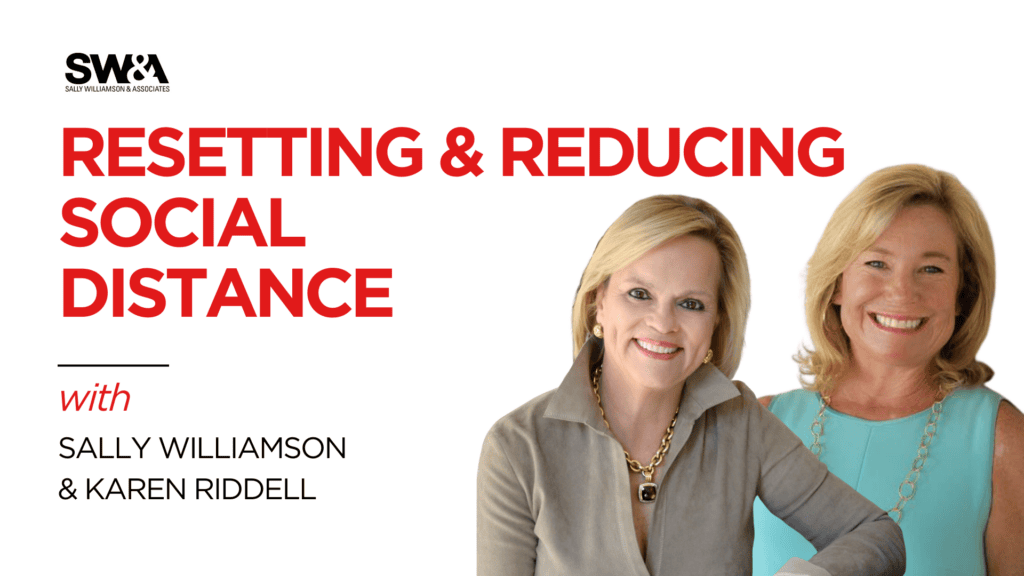
In this episode of What’s Your Story, Sally Williamson speaks with positive psychology coach and author Karen Riddell about friendship, social connection and the role relationships play in our lives.
Their conversation took place as people were beginning to reconnect after pandemic distancing. The immediate circumstances have changed, but the broader leadership question remains: how can organizations create opportunities for employees to know, trust and support one another without forcing relationships that must develop naturally?
Social distancing is a term that took hold during the pandemic as a descriptive way of creating boundaries from each other. But after two years of distancing and now going back to offices and social settings with colleagues and friends, social distance may take on new meaning.
At a minimum, the re-engagement in groups feels awkward at first. We’ve forgotten some of the social norms and feel a little rusty at small talk. In a corporate setting, we realize that Zoom calls didn’t allow for much of a relationship with colleagues. So, we aren’t quickly at ease as a member of the team. Virtual events just aren’t the same as taking time for lunch or going on a walk with a colleague or friend.
And now, we’re somewhere between anxious about reconnection, stressed about being left out or lonely because many of our friends have moved on. Our social life and world didn’t just relaunch or reset to where it may have been two years ago. We continue to hear from managers and leaders who are trying to accelerate connection and strengthen relationships across new work settings. And I think we’re all looking for some confidence in connection and some new ways of getting there.
In this episode, Sally talks with Karen Riddell, Sally’s long-time friend and Positive Psychology Life Coach who has taken a special interest in social connection in the workplace.
More about Karen Riddell
Karen Riddell is a Positive Psychology Life Coach, who started her business after her interest in friendship led her to become certified in applied positive psychology and life coaching.
In her coaching practice, she works with groups and individuals to find the sweet spot where their strengths, purpose and passions align. Karen partners with clients to clearly conceptualize their goals, envision the possibilities, and map out a concrete action plan for thriving. Karen’s practice centers on positivity, engagement, connection, purpose and vitality.
In December 2020, Karen published Friendship Matters, a book extolling the miraculous power of friendship to transform your life. The how-to book details specific, simple ways to find, make, and build new friendships as well as ways to enrich, deepen, and strengthen existing relationships. It also contains an easy-to-use workbook that allows the reader to create their own personal path to joy through friendship.
Prior to this, Karen received two degrees from The University of North Carolina, moved to Atlanta with her husband, where they had three daughters, and Karen became a prominent community volunteer. She is now writing her second book for mothers-of-the-brides sharing tips on how to navigate the complex process of wedding planning, and doing it with joy.
Show Notes
- Karen Riddell – Positive Psychology Life Coach
- After social distancing, people now feel awkward with re-engagement and out of the practice of social norms. They are anxious about reconnecting, stressed about being out, and lonely. Social distance is more than just physical space.
- For managers and leaders:
- What are some of the most significant challenges with the limited socialization over the last few years?
- The impact of social distancing is underestimated.
- We are experiencing a double pandemic – Covid is threatening our physical health and social distancing is threatening our mental health.
- Work is a structured social setting that fell through.
- What are some of the most significant challenges with the limited socialization over the last few years?
- Social connection strengthens us in all the vital facets in our lives. It brings us physical and mental health, stronger families and relationships, and success in the workplace. Social disconnections weaken us in all those areas.
- What about social anxiety?
- Pre-pandemic – FOMO (Fear of missing out)
- People now feel FOBI (Fear of being included)
- Social anxiety can feel different:
- embarrassed
- awkward
- uncomfortable in crowds.
- Social anxiety can be felt physically:
- heart racing
- sweating
- panic attacks
- Negative emotions cause us to want to avoid social settings, so we are reluctant to jump back in.
- People who live alone or had smaller social circles to start have struggled the most with social distancing—singles or anybody residing with an immunocompromised individual have as well. People with larger social circles or a family did not struggle as much.
- What can most individuals do to reacclimate to social connection?
- Start by taking a strategic approach to social interactions:
- Before an event or activity, think of simple ways to ease its pressure.
- Limit the time at the event.
- Plan to go with someone else.
- Think about who you will see and what you will talk about.
- Plan how to recharge batteries after.
- Plan at your own pace – start with people you know well.
- Be compassionate and patient with yourself. If you start to have negative thoughts, try to reframe the thoughts.
- Start by taking a strategic approach to social interactions:
- New ideas on how to bring socialization into a virtual workgroup?
- Most success comes from communication, not how but what you communicate about—balance work-related materials with social interactions.
- Internally and strategically interact virtually – using programs like slack
- Collaborate and create with virtual programs in real-time
- Grouping people in subsets and prompting group ice breakers
- Host contests and challenges
- Send humorous videos
- Host a lunch and learn
- Play up holidays
- Talk about families and hobbies
- Work to replace something spontaneous with something structured.
- Most success comes from communication, not how but what you communicate about—balance work-related materials with social interactions.
- What piqued Karen Riddells’ interest in this work?
-
- All the things she had done were not activities and jobs that she was particularly interested in, but she did them because of the people she enjoyed being around. This realization got her interested in the power of friendship.
- Friendship Matters by Karen Riddell
- Friendships are vital to health and happiness and are the key to physical and mental health.
- All the things she had done were not activities and jobs that she was particularly interested in, but she did them because of the people she enjoyed being around. This realization got her interested in the power of friendship.
-
- People with a strong network:
-
- have a better sleep experience
- less chance of getting a cold/flu
- teeth and skin are healthier
- less likely to have stress
- heal faster
- better cardiovascular health
- stronger immune system
- more likely to take preventative health manners
- stronger working memory
- less likely to suffer from anxiety and depression
- People with a solid social network will have up to a four times greater chance of survival. The hills and hurdles in life are easier to manage with friends by your side.
-
- How can you get a strong social circle?
- Start by getting a friendship/positive mindset – you need to be ready to get in the right space.
- Put your passions and interest in play.
- Introverted leaders- What if you don\’t have time to develop strong friendships?
-
- Any leader in a business environment needs to make it a priority to develop friendships – Streamline your efforts to what will be the most successful.
-
- The formula of great friendships
- 1. mutual respect and reciprocity
- 2. trust and vulnerability
- 3. devotion and commitment
- Companies struggling with employee retention – is friendship a retention tool?
- Gallup organization research shows:
- An employee with a friend at work is 7 times more likely to be engaged in their job. No friends, your chance of being engaged plummets to 1 in 12.
- Work friends reduce stress and burnout – friendships at work increase job satisfaction by nearly 50%.
- People with 3 or more friends at work are 96% more likely to be satisfied with their lives overall.
- Create the moments and allow people to use them in a way that works for them.
- Gallup organization research shows:
*Please note the following story does contain sensitive material. If you are struggling with suicidal thoughts, please contact the National Suicide Prevention Lifeline. Call 1-800-273-TALK (1-800-273-8255)
- Karen shares a story of being a new mother and getting out of a funk by getting active and developing a community. She then shares a similar story of her mother, who needed a community as she struggled with loneliness. She was suffering from postpartum depression in a new town.
Even just one friend has the power to make a difference.
Why Workplace Connection Matters
People do not need to become close friends with every colleague to work effectively. They do need relationships strong enough to support communication, trust and collaboration.
Workplace connection helps employees know:
- Who they can ask for help
- How colleagues prefer to communicate
- Which perspectives others bring
- When a concern should be raised
- Where responsibilities overlap
- How their work contributes to a larger goal
- Whether it is safe to ask questions or admit uncertainty
These connections affect everyday work.
A team with stronger relationships may address disagreement earlier, share information more freely and give one another the benefit of the doubt. A disconnected team may interpret brief messages negatively, avoid difficult conversations or remain within functional boundaries even when collaboration is necessary.
Gallup has found that having a best friend at work is associated with communication, commitment, retention and other business outcomes. Its current guidance emphasizes that close workplace relationships remain important across in-person, remote and hybrid settings. Gallup’s workplace research also notes that only two in ten U.S. employees report having a best friend at work.
Leaders cannot manufacture friendship. They can create an environment where stronger professional relationships have room to develop connection in the workplace.
Connection cannot be assigned, but it can be supported.
Connection Is Not the Same as Proximity
Working in the same building does not automatically create connection.
Employees can sit near one another and know very little about each other’s priorities, pressures or strengths. Remote colleagues may have strong relationships despite rarely meeting in person.
The difference is the quality of the interaction.
Task-based communication helps work move forward. Relational communication helps people understand who they are working with.
Teams need both.
A calendar filled with meetings may still provide little opportunity for meaningful connection if every interaction is tightly structured around tasks. Employees may know what their colleagues are doing without knowing how to work effectively with them.
Leaders should look beyond attendance and ask:
- Do team members understand one another’s roles?
- Do employees know where to seek help?
- Are people comfortable raising concerns?
- Does the team make time to discuss how it works together?
- Are newer employees included in informal communication?
- Do remote employees have equal access to relationships?
- Can people disagree without damaging trust?
These questions offer a clearer view of connection than the number of days employees spend in an office as it pertains to connection in the workplace.
Seven Ways Leaders Can Strengthen Team Relationships
1. Create Space for Conversation
Connection often grows in the moments around the work.
Before distributed work became common, employees might talk while walking to a meeting, waiting for coffee or having lunch. Virtual and highly scheduled environments removed many of those unplanned moments.
Leaders can create room for conversation without turning every interaction into an activity.
Options include:
- Beginning meetings with a brief personal check-in
- Leaving time before or after a working session
- Hosting optional coffee or lunch conversations
- Pairing employees from different functions
- Creating informal channels for shared interests
- Encouraging walking conversations when practical
- Protecting time at team gatherings for unstructured interaction
The goal is not constant socializing. It is giving people enough opportunity to become more familiar and comfortable with one another to achieve connection in the workplace.
2. Make Meetings More Human
Meetings reveal how a team relates.
If every meeting is dominated by status updates, employees have little opportunity to ask questions, exchange ideas or understand different perspectives.
Leaders can create greater connection by asking:
- What are you learning?
- Where do you need help?
- What should the rest of the team understand?
- Which issue would benefit from another perspective?
- What is creating unnecessary difficulty?
- What progress should we recognize?
These questions shift the meeting from a series of individual reports to a team conversation.
Leaders should also notice who participates. If the same few people speak every time, use smaller groups, written input or round-robin discussion to make participation more accessible connection in the workplace.
3. Build Connection Into the Work
Team relationships strengthen when people accomplish something together.
Social activities may help, but collaboration on meaningful work often creates a more durable connection. Employees learn how colleagues think, respond to pressure and contribute.
Leaders can create cross-team connection through:
- Shared problem-solving
- Cross-functional projects
- Peer reviews
- Mentoring relationships
- Short-term working groups
- Collaborative planning
- Job shadowing
- Communities of practice
- Rotating meeting leadership
The project should have a real purpose. Manufactured collaboration can feel like additional work without meaningful value to develop connection in the workplace.
4. Support Different Levels of Social Comfort
Not everyone connects in the same way.
Some employees enjoy large gatherings. Others prefer one-on-one conversations or small groups. Remote employees, introverted colleagues, caregivers and employees with health or accessibility concerns may experience social expectations differently.
Offer multiple ways to participate.
For example:
- A large social event
- A small-group lunch
- A virtual interest group
- A peer partnership
- A structured project
- An optional informal conversation
Avoid treating one style as the standard for engagement.
A person can be deeply committed to the team without wanting to attend every social activity. Leaders should create opportunity without requiring employees to perform sociability.
Belonging grows when people can participate without pretending to be someone else.
5. Help New Employees Form Relationships
A new employee may learn the job without learning the network.
Formal onboarding usually covers systems, policies and responsibilities. It may not explain who holds important knowledge, which teams depend on one another or how decisions are influenced.
Help new employees build a useful relationship map.
Introduce them to:
- Immediate teammates
- Cross-functional partners
- Subject-matter experts
- People who have held similar roles
- Colleagues who joined recently
- Leaders whose priorities affect the work
- Individuals who can explain the organization’s history
A single assigned contact may help with basic questions, but connection should not depend entirely on one relationship.
Managers should check whether the employee is building a network, not only completing onboarding tasks.
6. Strengthen Manager Communication
Managers shape much of an employee’s day-to-day experience.
Gallup’s current employee-engagement guidance identifies caring managers and ongoing conversations as important drivers of engagement. It also emphasizes trust, clarity and regular dialogue rather than relying on isolated activities. Gallup’s engagement guidance supports the idea that managers play a central role in helping employees feel connected to their work and workplace.
Managers can strengthen connection through regular conversations about:
- Priorities
- Progress
- Challenges
- Development
- Workload
- Team relationships
- Recognition
- Support
These conversations should not become personal interrogations. The manager’s role is to show interest, listen and respond appropriately.
A leader who knows what an employee is working through can provide more relevant support and connect that person with the right colleagues to develop connection in the workplace.
7. Make Connection Consistent
One team event will not repair a disconnected culture.
Connection develops through repeated experiences that demonstrate:
- People are heard
- Questions are welcome
- Help is available
- Contributions are recognized
- Commitments are honored
- Disagreement can be productive
- Employees are included in information and decisions
Leaders should evaluate connection as an ongoing part of how the team works.
Questions for a periodic team discussion might include:
- Where are we collaborating well?
- Where are handoffs breaking down?
- Who needs to be included earlier?
- What information is difficult to access?
- How could our meetings help us work better together?
- Which relationships would strengthen the work?
The answers can guide practical changes rather than another temporary initiative and build connection in the workplace.
Building Connection on Hybrid and Virtual Teams
Hybrid work can create different experiences within the same team.
Employees who spend more time in the office may have access to informal conversations and relationships that remote colleagues miss. Remote employees may receive the formal information but not the context surrounding it.
Leaders can reduce that gap by:
- Sharing decisions in common channels
- Avoiding important side conversations that exclude remote employees
- Giving virtual participants an intentional place in discussions
- Rotating meeting times when teams span regions
- Using written collaboration before live meetings
- Scheduling individual conversations
- Creating cross-location working partnerships
- Bringing people together in person when the purpose justifies it
- Evaluating contribution based on results rather than visibility
Virtual connection also requires communication beyond tasks.
A team may use Slack, Teams or another platform all day and still feel disconnected if every exchange is transactional. The tool does not create the relationship. The way people use it does.
Leaders can model communication that includes appreciation, curiosity, recognition and appropriate personal interest to foster connection in the workplace.
Replace Spontaneity With Intention
Distributed teams cannot replicate every spontaneous office interaction. They can create new habits that serve a similar purpose.
Examples include:
- Optional virtual coffee pairings
- Short peer learning sessions
- Informal project debriefs
- Recognition channels
- Interest-based groups
- Collaborative planning documents
- Small-group discussions during larger meetings
- Occasional in-person gatherings with a clear purpose
Structured connection should not feel relentless. Employees also need uninterrupted time to work.
The right rhythm gives people opportunities to connect without creating another layer of meeting fatigue.
What Leaders Should Avoid
Forced Friendship
Leaders can create opportunities for connection, but should not pressure employees to disclose personal information or form particular relationships.
Mandatory Fun
Social events can strengthen relationships when they are inclusive and thoughtfully designed. They become counterproductive when employees feel trapped, exposed or judged for not participating enthusiastically.
Overreliance on Technology
Collaboration platforms help people communicate. They do not automatically create trust or belonging.
Favoring Visible Employees
Hybrid leaders should be careful not to give more access, recognition or opportunity to people they see in person most often.
Treating Connection as an HR Initiative
Team connection is shaped by everyday leadership behavior. It cannot be delegated entirely to HR, events or employee resource groups.
Communication Creates Connection
Connection depends on more than liking the people you work with.
It grows through communication behaviors that build trust:
- Listening without rushing to respond
- Asking thoughtful questions
- Sharing context
- Acknowledging another perspective
- Giving clear feedback
- Following through
- Recognizing contributions
- Addressing tension directly
- Admitting when an answer is unknown
- Making space for quieter voices
These behaviors are especially important for leaders because their communication influences the entire team’s norms.
If a leader interrupts, withholds information or avoids difficult conversations, employees learn to protect themselves. If the leader listens, explains decisions and responds constructively to disagreement, employees have more reason to engage openly.
Content, Style and Situation
SW&A evaluates leadership communication through Content, Style and Situation.
Content includes the information leaders share, the questions they ask and the clarity they provide.
Style includes how leaders listen, respond and make other people feel during an interaction.
Situation includes the relationship, work environment, communication channel and needs of the audience.
A virtual check-in, team meeting, difficult conversation and company-wide message each require a different approach. Leaders strengthen connection when they adapt while remaining consistent in how they treat people.
Like what you hear on connection in the workplace? Hear more episodes like this on the What’s Your Story podcast page!