
How to Use AI for Business Communication
AI can help you develop business communication faster. It can organize ideas, suggest language, identify gaps and give you a useful starting point. But faster does not always mean clearer, more credible or more effective.
The real question is not whether leaders should use AI for business communication. It is how they can use it without losing the judgment, personality and audience awareness that make communication believable.
Over the last several years, I have reviewed speeches, meeting outlines, emails and executive messages developed with AI. The technology has improved quickly, but the same risks continue to surface. Information goes unchecked. Language sounds polished but generic. Stories appear that do not belong to the person telling them. And a tool designed to support the communicator begins to replace the communicator.
Used thoughtfully, AI can become a valuable communication partner. It can help structure your thinking, strengthen a first draft and test whether an idea is clear. But you still have to guide the process, verify the content and put yourself back into the message.
Here are three ways to use AI while keeping your communication accurate, authentic and distinctly yours.
AI for Business Communication: How Can AI Improve Business Communication?
Last year, I wrote a newsletter called “Can Chat GPT write my speech?” And essentially, I said AI can get you to a first draft. Over the last year, as we’ve worked with it and seen others apply it to communication, I would say it’s gotten better than that. But I also agree with the stats that say AI gets things 70% right.
Because I see the 30% wrong almost every day. At this point, I’ve seen and edited hundreds of meetings, speeches and presentations built by an AI engine. Here’s what happens:
AI goes unchecked. At least once a week, I see copies of unchecked work. One presenter confused industries by misspelling the name of a company in AI. The insights were good on another industry, but it led the communicator down the wrong path with the prospect.
AI goes uncoached. I saw a keynote recently written for a top leader. An analogy was included that aligned to the content, but not to him. He’s telling a story about coaching 8-year-old girls in soccer. He doesn’t have an 8-year-old, he doesn’t even have a daughter. So, it wasn’t authentic to him.
If you check AI and coach AI, it can adjust. But if you think of AI as just getting things done faster, you will be the next victim of the 30%. And if you’re okay with 30% wrong, then this newsletter won’t be helpful to you. But if you believe, like I do, that communication should be memorable and repeatable, then you need to leverage AI as an innovation and still keep yourself front and center in your content.
AI for Business Communication: These guidelines will help you develop a strong partnership with AI.
First structure. In our workshops, we talk about communication as a journey. The communicator should be leading the listener to a destination. AI cannot create the journey. But it can follow structure. In fact, it probably does. But if you aren’t setting the structure, you have no idea where AI got the structure it uses. In the SW&A toolkit, we call structure the storyline. And while we know data points and insights are helpful, it’s the structure that keeps the listener on the journey.
Second, language. It takes me 30 seconds or less to tell that a script, outline or email was written by AI. If the rest of us know it, why isn’t the communicator worried about that? AI is like leveraging an encyclopedia. It brings knowledge and insight quickly. But there’s nothing conversational about its output. You have to work with AI content to transfer it to your words and your language.
If you’re earnest about being believable as a communicator, AI can’t get you there. It doesn’t know you. Everyone else in the room does. And that’s why it isn’t believable. In fact, the rest of us would say it isn’t even your words. And aren’t you better than that?
Third, personalize it. As a communicator, you should be working for more than believable. You should be working toward engaging and empathetic.
What listeners love about a good communicator is when we spend 30 to 45 minutes listening to them, we feel like we get to know them through what they share and how they talk about a product, direction, or a strategy. AI can tighten a story or help you package it in a fun way. But don’t talk about coaching a girls’ soccer team if you don’t have a daughter. Personalizing content and being open and honest with audiences has always been hard work. And it will continue to be for those who want to be better than 70%.
AI for Business Communication: Where AI Helps and Where Human Judgment Still Matters
The best way to leverage AI tools is as a great partner and tool that can enhance something or add something for you. It might be insights or case studies or background. It can save a lot of time and get you to a better product. But you have to put the YOU into communication every time.
We have been learning to integrate it and adapt it ourselves. And we’re feeling good about AI as a partner. But I’m not nearly as interested in helping AI become a good communicator as I am in helping each of you get there. And that’s why our efforts have been on coaching AI on storyline structure, so you can adjust the language and add the personalization to keep communication unique to you. And now, we’ve got the tool that can help you get beyond 70%.
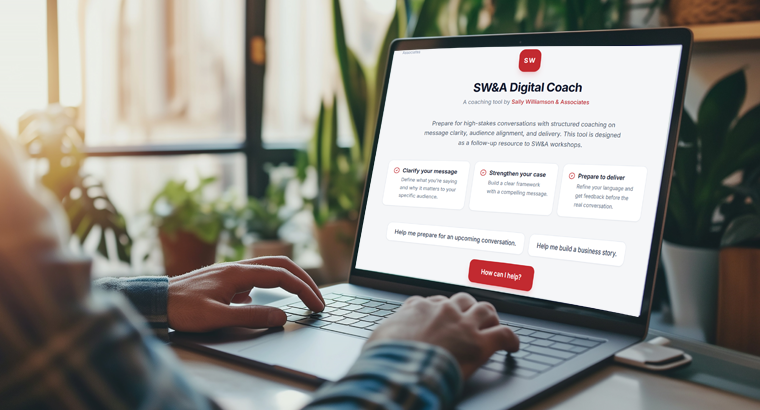
We’ve launched the SW&A Digital Coach. It works in an app to leverage our toolkit for outlining content with an AI engine that guides you to craft a compelling message and the right flow of ideas to take a listener on a journey. And who wouldn’t want SW&A, and our language, guiding the outlining process?
Here’s how you can try it for AI for Business Communication!
Former Students: On Your Own: If you’ve taken our storyline program and already worked with the SW&A methodology, it’s all yours. We’ll give you a link to the app, and you can build three outlines on us. If you love the tool, you can purchase more uses. If not, you got a lesson in AI as a communication partner.
Former Students: A Guided Tour: If you’re a former student, but sheepishly admit you don’t remember the storyline structure, you can take a quick refresher and learn the tool in a 90 min hosted webinar.
Team Workshop: If you haven’t worked with us but think we might be onto something, you can book a workshop for your team. We’ll incorporate the AI tool into an in-person or virtual program. And we’d be happy to do this for our former students as well!
The best part of all of this is learning to leverage AI for business communication. But if you stop at 70% effective, you’ve missed the value. You’re working faster but you aren’t getting better results. In fact, from what we see, it may be getting worse. But if you learn to leverage AI as a partner, you can get to 100%—and that’s our standard for a great communicator!
AI for Business Communication: Review Before You Send
AI can produce a polished draft in seconds. That speed makes it tempting to move directly from prompt to send.
But a finished-looking draft is not necessarily a finished message.
Before using AI for business communication, take the content through a deliberate human review. The communicator remains responsible for the accuracy, relevance and impact of the final message.
AI for Business Communication: Verify the Information
Begin with accuracy.
Check names, titles, dates, statistics, quotations and company information. Confirm that examples are real and that any conclusions are supported by reliable sources.
AI can present incorrect information with the same confidence and polish it uses for accurate information. If a fact matters to the credibility of the message, verify it independently.
Leaders should also follow their organization’s policies before entering confidential, proprietary, employee or customer information into an AI tool.
AI for Business Communication: Check the Audience and Purpose
Next, return to the audience.
What do listeners already know? What do they care about? What decision, reaction or action does the communication need to create?
AI often produces more background than an audience needs. Remove information that does not help the listener reach the intended destination. Strengthen the ideas that connect directly to the audience’s priorities.
If the draft could be sent to almost anyone, it probably has not been tailored enough.
AI for Business Communication: Restore Your Voice
Read the content aloud.
Would you actually use these words in a conversation? Does the sentence length sound natural? Are there phrases that feel overly formal, repetitive or generic?
Replace language you would never say. Add examples, experiences and observations that belong to you. A few specific details can make the difference between content that sounds generated and communication that sounds credible.
The goal is not to make AI sound human. It is to make the final communication sound like you.
AI for Business Communication: Confirm the Action
Finally, make sure the listener knows what to do with the information when it comes to AI for business communication.
Is the recommendation clear? Is the request specific? Does the audience understand what should happen next and why it matters?
AI for business communication is most useful when it helps a communicator think, organize and refine. It becomes less useful when the ease of generating words replaces the discipline of making choices.
Use AI to accelerate the process. Keep human judgment responsible for the outcome.
Call us when you need us! Whether for AI for Business Communication or anything else!
Also Read: “Can Chat GPT write my speech?” For additional insight on AI for Business Communication.
Talk to Us About What’s Right for You → | Explore Tailored Programs → | LinkedIn →