
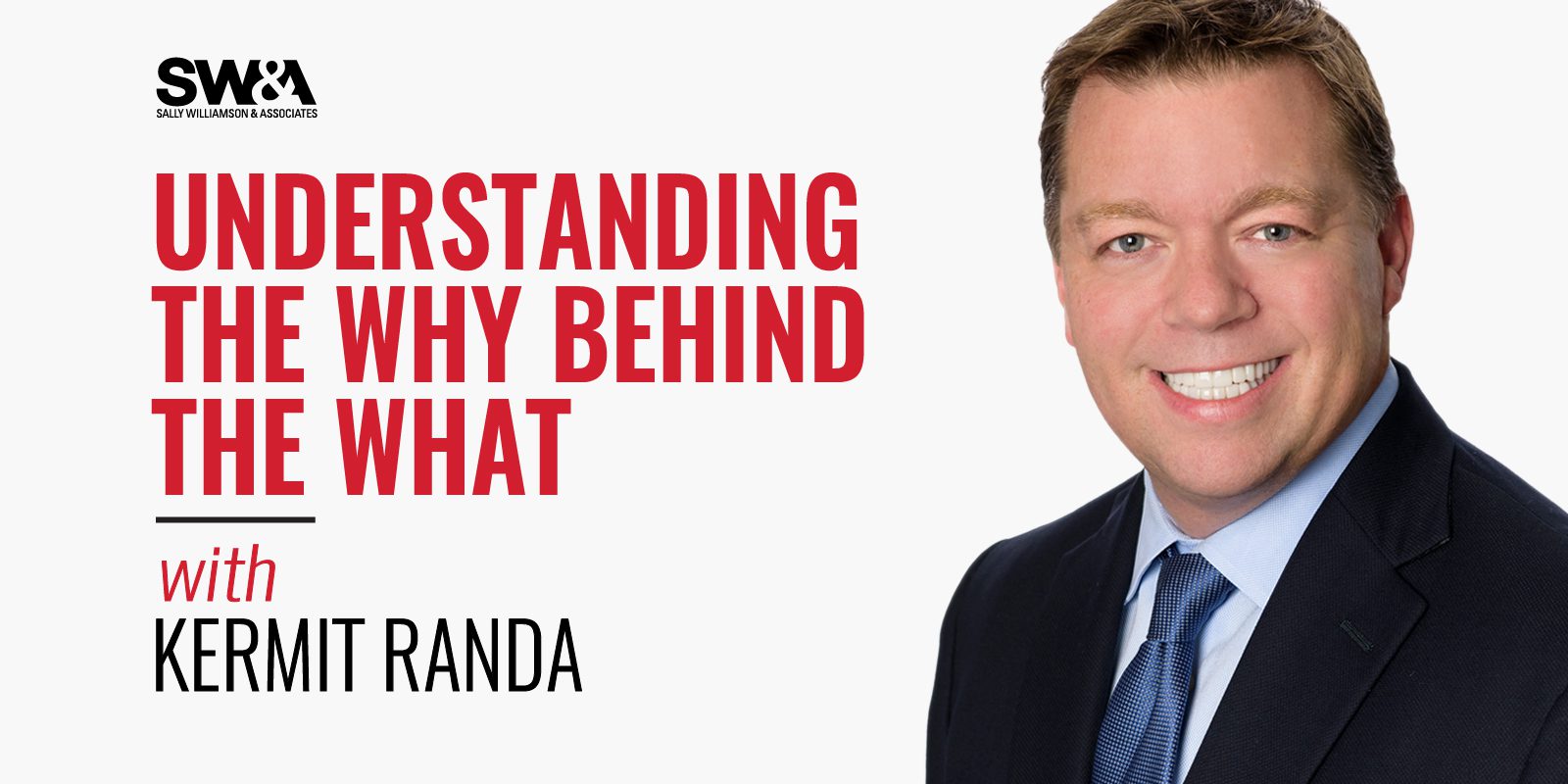
Understanding the Why Behind the What: Leadership Lessons with Kermit Randa
The First 90 Days as a New Leader
A new leader often feels pressure to demonstrate value immediately.
Employees expect direction. Senior executives expect progress. Customers and stakeholders want confidence that the transition will not interrupt the work.
That pressure can tempt a leader to begin with answers.
But the first responsibility of a new leader is often to understand the organization well enough to know which answers matter.
In this episode of What’s Your Story, Sally Williamson talks with executive Kermit Randa about what leaders should learn during their first 90 days. Their conversation explores disciplined listening, employee surveys, data synthesis and the communication required to turn thousands of individual observations into a clear direction people can understand.
Effective leadership training goes beyond learning how to manage teams. It helps leaders listen more intentionally, turn information into clear direction and communicate the context employees need to understand not only what is changing, but why it matters. In this episode of What’s Your Story?, Kermit Randa shares how he uses listening, data and storytelling to lead with greater clarity and connection.
Today, we’re going to be chatting with Kermit Randa about the power of story and the struggles leaders must endure during the first 90 days at a new company. How do leaders settle into their roles and what sorts of pressures do they feel? What strategies are most important to implement in the first three months?
As Chief Executive Officer of Kaufman Hall’s Software division, Kermit Randa oversees all product development, sales, implementation, training, and support functions for the firm’s Axiom and Peak Software products.
Kermit Randa has more than 20 years of experience spanning healthcare and software. His areas of expertise include enterprise software insights and adoption, business transformation and innovation, strategic partnership cultivation and management, and risk identification, monitoring, and mitigation. Prior to Kaufman Hall, he served as Chief Growth Officer with Waystar, and Chief Executive Officer for PeopleAdmin.
Kermit Randa received his M.H.A. from Xavier University. He completed the Advanced Management Program at Harvard Business School and is a Fellow of the American College of Healthcare Executives.
Kermit Randa is a strong supporter of data gathering and utilizing information to guide decision-making processes. In today’s episode, Kermit Randa will explain that power behind surveys and offer us a glimpse into how he and his team sorted nearly 90k data points into condensed, actionable intelligence. How do top leaders utilize modern technology and fast communication? Find out more on today’s episode.
Show Highlights
How Leaders Communicate Context Clearly
- 3:25 How did Kermit Randa get started? What was most important to learn about the business? How did surveys play into this discovery process?
- 8:30 Learn to listen and be disciplined in what you’re listening for. Are leaders asking the same things throughout their information collection process? Why does it matter?
- 11:35 How did Kermit Randa and his team break down more than 89k data points into actionable information in under three months? Which facets of business have been guided by this information?
- 14:00 How did Kermit Randa take all of the information he gathered then synthesize it into what he wanted to say to employees?
- 24:09 How do leaders determine how much context to give to employees? How do you offer them clarity? Kermit Randa asks himself, “What does this sound like at the kitchen table?”
- 27:25 How has Kermit Randa personalized himself to his employees through the power of story? Kermit Randa tells his story and explains how he knows this story works. “Opportunity doesn’t come from a thing… Opportunity comes from a person.”
Guest Information
Kermit Randa is characterized as an inclusive leader, one who inspires accountability and a results-oriented focus to achieve sustained outcomes. Kermit Randa understands and capitalizes on change initiatives to deliver results that drive increased market success. He pursues new challenges with positive energy and builds relationships with stakeholders, peers, clients, and other corporate leaders.
You can find more information about Kermit Randa on Linkedin.
Listen Before You Lead
A new leader enters the organization with experience, ideas and expectations. The organization already has its own history, relationships and understanding of what has worked.
Both perspectives matter.
The leader can bring a fresh view, but acting too quickly may lead to solutions that address the wrong problem. Waiting too long can create uncertainty and make employees question whether the leader has a direction.
Disciplined listening helps balance those risks.
Listening does not mean delaying every decision or accepting every opinion as fact. It means gathering enough information to understand the organization before making broad conclusions about it.
A new leader should learn:
- What employees believe is working
- Where customers experience frustration
- Which processes create unnecessary difficulty
- How decisions are actually made
- Which priorities compete with one another
- Where trust is strong or fragile
- What has been tried before
- Which expectations have not been met
- What employees fear losing
- What they hope the new leader will change
These conversations help the leader understand the “why” behind the organization’s current reality.
New leaders build credibility by showing that their direction is informed by what they took the time to understand.
What Should a New Leader Learn?
The first 90 days should produce more than a collection of introductory conversations.
The leader needs a working understanding of the business and the people responsible for it.
The Business
What creates value? Where is growth expected? Which customer needs are changing? What financial, operational or competitive pressures shape decisions?
The Organization
How are teams structured? Where do responsibilities overlap? Which processes support the work and which ones slow it down?
The Culture
What behaviors are rewarded? How directly do people communicate? What happens when someone disagrees, raises a risk or makes a mistake?
The People
Who holds important knowledge? Which relationships influence decisions? Where are employees engaged, frustrated or uncertain?
The Expectations
What does the board, executive team or parent organization expect from the new leader? What must change, and what should remain stable?
A leadership transition becomes easier to navigate when these areas are considered together. A strategic decision that makes sense financially may fail if the leader overlooks the culture or the people needed to implement it.
Five Priorities for a New Leader’s First 90 Days
1. Ask Consistent Questions
When a new leader speaks with dozens or hundreds of people, consistency matters.
If every conversation follows a completely different path, the leader may collect interesting observations but struggle to compare them. A core set of questions makes patterns easier to recognize.
Useful questions include:
- What should this organization continue doing?
- What creates the greatest difficulty for your team?
- Where do we make work harder than it needs to be?
- What do our customers value most?
- Which issue needs leadership attention?
- What is one thing you hope I do not change?
- If you were in my role, where would you begin?
- What have previous improvement efforts missed?
- What information do employees need from leadership?
- What would meaningful progress look like?
The conversation should still feel human. The questions provide structure, not a script that prevents the leader from following an important idea.
2. Listen for Patterns
One employee’s experience may be meaningful, but it may not represent the whole organization.
Leaders need to distinguish between isolated comments, strongly held individual opinions and patterns that appear across roles, teams or locations.
Kermit describes gathering and analyzing nearly 90,000 data points during his early months in a leadership role. The volume is striking, but the greater leadership challenge was turning that information into something useful.
A leader should look for:
- Ideas repeated across different groups
- Gaps between leadership and employee perceptions
- Issues that appear in both customer and employee feedback
- Processes that create several seemingly unrelated problems
- Concerns employees hesitate to state directly
- Areas where the available data contradicts assumptions
- Strengths the organization may be underusing
Patterns create a stronger basis for decisions than the loudest individual comment.
3. Separate Symptoms From Causes
The first explanation of a problem is not always the underlying cause.
Employees may say communication is poor when the actual issue is inconsistent decision-making. A team may request more resources when priorities are unclear. Customer frustration may appear to be a service issue but originate in a broken internal process.
New leaders should continue asking why.
For example:
- Why are projects repeatedly delayed?
- Why are decisions revisited?
- Why do teams interpret the same priority differently?
- Why does information fail to reach the people who need it?
- Why did an earlier change effort lose momentum?
- Why are employees hesitant to raise concerns?
This is the “why behind the what.”
Understanding the cause helps the leader avoid announcing a quick solution that addresses only the visible symptom.
4. Translate Information Into Priorities
Listening creates expectations.
When employees give a leader their time and perspective, they expect the information to lead somewhere. The leader cannot act on every suggestion, but should be able to explain what was learned and how it shaped the priorities.
The challenge is synthesis.
A useful leadership message should clarify:
- What the leader heard
- Which themes appeared most consistently
- What those themes mean for the organization
- Which priorities will receive attention
- What will not change immediately
- What decisions still require more information
- What employees should expect next
- How progress will be communicated
This translation turns thousands of individual observations into a shared understanding.
Gathering feedback creates interest. Explaining what you learned creates trust.
5. Communicate What Happens Next
Employees may initially give a new leader time to learn. That patience will not last indefinitely.
By the end of the listening period, people need a sense of direction.
The leader’s message does not need to answer every question or announce a complete transformation. It should show that listening produced understanding and that understanding is beginning to shape action.
A strong transition message might include:
- What I set out to learn
- Who I heard from
- What I heard consistently
- What surprised me
- What we should preserve
- What needs attention
- Where we will begin
- How you will remain involved
This structure demonstrates respect for the listening process while creating momentum.
How to Turn Employee Feedback Into Action
Employee surveys and listening sessions often generate more information than leaders can use immediately.
The value does not come from the number of responses. It comes from the decisions those responses inform.
Leaders can make employee feedback more useful by:
- Asking questions connected to real business priorities
- Using consistent categories
- Comparing responses across groups
- Looking for repeated language and themes
- Testing conclusions against operational data
- Identifying what is within leadership’s control
- Assigning ownership for next steps
- Communicating which actions will follow
- Measuring whether those actions make a difference
Leaders should also be transparent about what they cannot change.
Silence after a survey damages trust. So does promising action on every suggestion. Employees usually understand that leadership must consider costs, competing priorities and business constraints. They still need evidence that their feedback was considered.
How Much Context Do Employees Need?
One of the most useful questions in the episode is: “What does this sound like at the kitchen table?”
It is a reminder that employees discuss organizational decisions away from formal meetings and leadership announcements. They explain those decisions to colleagues, friends and family in ordinary language.
If the message is too complex to repeat, it may not travel accurately.
Leaders should provide enough context for employees to understand:
- What is changing
- Why the change is necessary
- How the decision was reached
- What will remain the same
- How employees will be affected
- What is expected of them
- Where they can ask questions
Context does not mean sharing every detail.
The leader’s responsibility is to determine which information employees need to interpret the decision accurately and act appropriately.
A useful test is whether an employee can explain the decision in a few clear sentences without relying on internal jargon.
Why Stories Matter During a Leadership Transition
Data can reveal what is happening across an organization. Stories help people understand what that information means.
A new leader can use stories to:
- Explain personal values
- Make a strategic priority more tangible
- Show what customer impact looks like
- Recognize an important organizational strength
- Demonstrate a desired behavior
- Explain why a change matters
- Help employees understand the person behind the role
Kermit discusses using his own story to become more personally known to employees. That matters because people do not build trust only through a leader’s title or strategic plan. They also want to understand what has shaped the leader and how that experience informs the way the person will lead.
A personal story should serve the audience. It should reveal something relevant about the leader without turning an organizational message into an autobiography.
One memorable idea from the conversation is that opportunity comes through people. Careers, businesses and changes move forward because someone offers support, shares insight, opens a door or takes a chance.
That idea gives employees a clearer sense of the values behind the leader’s approach.
Content, Style and Situation
A new leader’s first 90 days require attention to Content, Style and Situation.
Content includes the questions the leader asks, the information gathered and the message that emerges from it.
Style shapes how employees experience the leader during conversations. Curiosity, presence, listening and responsiveness influence whether people believe the leader genuinely wants to understand.
Situation includes the organization’s history, employee expectations, business pressures and reason for the leadership transition.
A listening strategy that works after a successful succession may not work during a crisis or restructuring. The leader must adapt the approach to the circumstances while remaining clear about the purpose.
About Kermit Randa
At the time of the original conversation, Kermit Randa was CEO of Kaufman Hall’s software division, overseeing product development, sales, implementation, training and support for its software products.
His later leadership roles have included CEO positions at Syntellis Performance Solutions and Symphony Talent. Because the episode is several years old, describe his Kaufman Hall role as his position at the time of the recording rather than as a current title. Kaufman Hall documented the division’s later transition into Syntellis in its 2020 company announcement.
Kermit’s experience spans software, healthcare, education, talent acquisition and organizational transformation. In this conversation, he shares how disciplined listening and data synthesis helped him establish priorities during a leadership transition.
Follow Us on LinkedIn for more insights and podcasts.
Like what you hear? Hear more episodes like this on the What’s Your Story podcast page!